Artemis II is NASA's first crewed mission in the Artemis program, marking humanity's return to lunar space with astronauts for the first time since Apollo 17 in 1972. It is a critical test flight of the Space Launch System (SLS) rocket and Orion spacecraft with a crew aboard, paving the way for future lunar landings (like Artemis III) and sustained human presence on the Moon.
Mission Overview
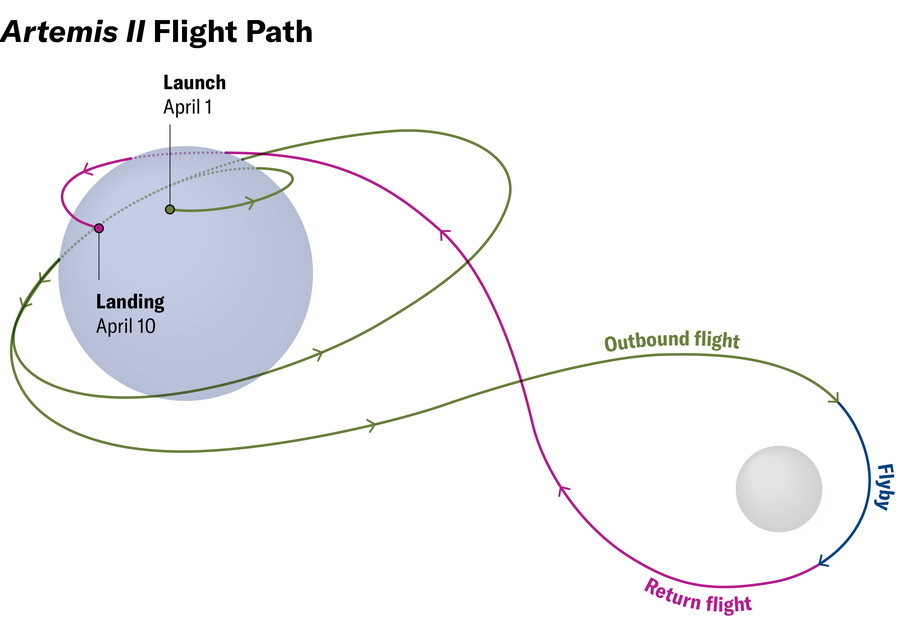
- Launch Date: April 1, 2026, at approximately 6:35 p.m. EDT from Launch Pad 39B at Kennedy Space Center, Florida.
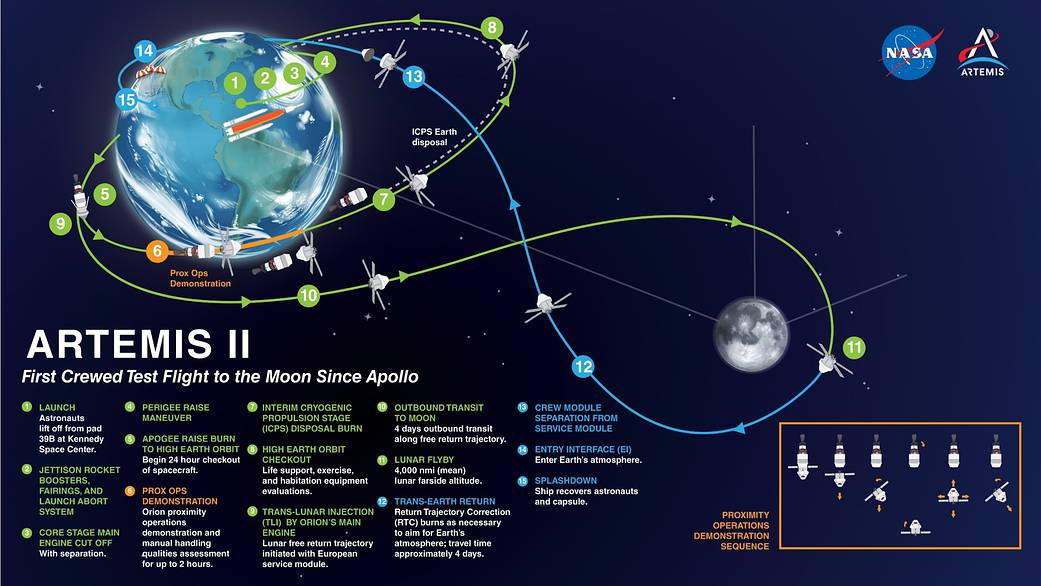
- Duration: Approximately 10 days (splashdown targeted for April 10, 2026, in the Pacific Ocean off San Diego).
- Trajectory: A "free-return" figure-eight path. The crew orbits Earth a couple of times, performs a translunar injection burn, flies around the Moon (including the far side), and returns using Earth's gravity. No lunar orbit insertion; it's a flyby at about 4,000 miles (closest approach) from the lunar surface.
Objectives
The primary goal is to test Orion's systems with humans in deep space:
- Validate life support, propulsion, power, thermal control, navigation, and communication systems.
- Demonstrate crew operations, including manual piloting, habitability assessments, and emergency procedures.
- Conduct science activities: lunar observations (near and far side), Earth imaging, and human health studies.
- Break the Apollo 13 farthest-distance-from-Earth record (surpassed on April 6, 2026, at over 248,655 miles).
- Gather data for future missions, including proximity operations and re-entry/splashdown.
As of April 8, 2026, the mission is in progress: the crew has completed the lunar flyby (April 6–7), lost communications briefly behind the Moon, taken stunning images, and is heading back to Earth.
Crew
The diverse international crew includes:
- Commander Reid Wiseman (NASA) — Veteran astronaut.
- Pilot Victor Glover (NASA) — Experienced ISS astronaut.
- Mission Specialist Christina Koch (NASA) — Record-holder for longest single spaceflight by a woman.
- Mission Specialist Jeremy Hansen (CSA, Canada) — First Canadian to fly beyond low Earth orbit.


Spacecraft and Rocket
- SLS Rocket: The most powerful rocket NASA has built; it launched Orion into orbit. It also deployed small CubeSats for secondary science.
- Orion Spacecraft: Crew module (for 4 astronauts) + European Service Module (propulsion, power, etc.). It features advanced life support and heat shield for high-speed re-entry.

Key Mission Milestones (Approximate Timeline)
- Launch & Ascent (Day 1).
- Earth Orbits & Systems Checks.
- Translunar Injection Burn (outbound to Moon).
- Outbound Coast & Lunar Flyby (peak science and distance record).
- Return Trajectory (inbound, Earth re-entry).
- Splashdown (Pacific Ocean recovery).
Significance
Artemis II tests critical technologies for Artemis III (planned crewed lunar landing) and beyond, toward a lunar Gateway station and eventual Mars missions. It emphasizes international collaboration (e.g., ESA's service module, CSA astronaut) and diversity in exploration.
Artemis II: A Personal Tribute on the Moon
Mission Overview
Artemis II is NASA’s first crewed lunar mission in more than five decades after Apollo-era flights. The mission is designed to send astronauts around the Moon in the Orion spacecraft without landing, testing critical systems for future human landings under the Artemis program. Launched from Kennedy Space Center, the spacecraft travels hundreds of thousands of kilometers from Earth, reaching deep space before looping around the Moon and returning safely. This mission represents a major step toward establishing a sustained human presence on the Moon and eventually preparing for missions to Mars.
The Crew Members
The Artemis II crew consists of four highly experienced astronauts: Reid Wiseman, the mission commander; Christina Koch, known for her long-duration spaceflight record; Victor Glover, a skilled pilot and mission specialist; and Jeremy Hansen, representing Canada and making history as part of the international collaboration. Together, they symbolize not only technological progress but also global unity in space exploration.
The Emotional Tribute
During the mission, a deeply personal moment emerged when Commander Reid Wiseman chose to honor his late wife, who had passed away before the mission. While observing the Moon’s surface, the crew noticed a particularly bright and striking region. In a heartfelt gesture, they informally named this “bright spot” after her. This act transformed a scientific observation into a deeply human tribute, reflecting how astronauts carry their personal memories and emotions even into the vast emptiness of space. It added an emotional layer to the mission, making it not just about exploration, but also about remembrance and love.
What is the “Bright Spot” on the Moon?
The “bright spot” observed by the crew is most likely a highly reflective lunar feature, such as a fresh impact crater or an area where lighter-colored rock is exposed. These regions reflect more sunlight compared to their surroundings, making them appear prominent when viewed from space. While the naming of this feature is not officially recognized by scientific bodies, it holds symbolic importance for the crew. Such informal naming often occurs during missions as astronauts interact closely with celestial landscapes.
Human Side of Space Exploration
This tribute highlights the emotional and human dimension of space travel. Astronauts are not just scientists and explorers; they are individuals with personal lives, relationships, and memories. Even while operating in extreme and highly technical environments, they remain connected to their loved ones. Moments like these remind us that space exploration is not only about rockets and missions but also about the human spirit, resilience, and emotional connections that transcend Earth.
Significance of the Moment
The gesture by the Artemis II crew has resonated widely because it blends science with humanity. It shows that even in one of humanity’s most advanced missions, personal stories still matter. This moment has become a symbol of how exploration and emotion coexist, reinforcing the idea that space missions are not just technological achievements but also deeply human journeys. As humanity returns to the Moon, such stories make these missions more relatable and meaningful to people on Earth.